
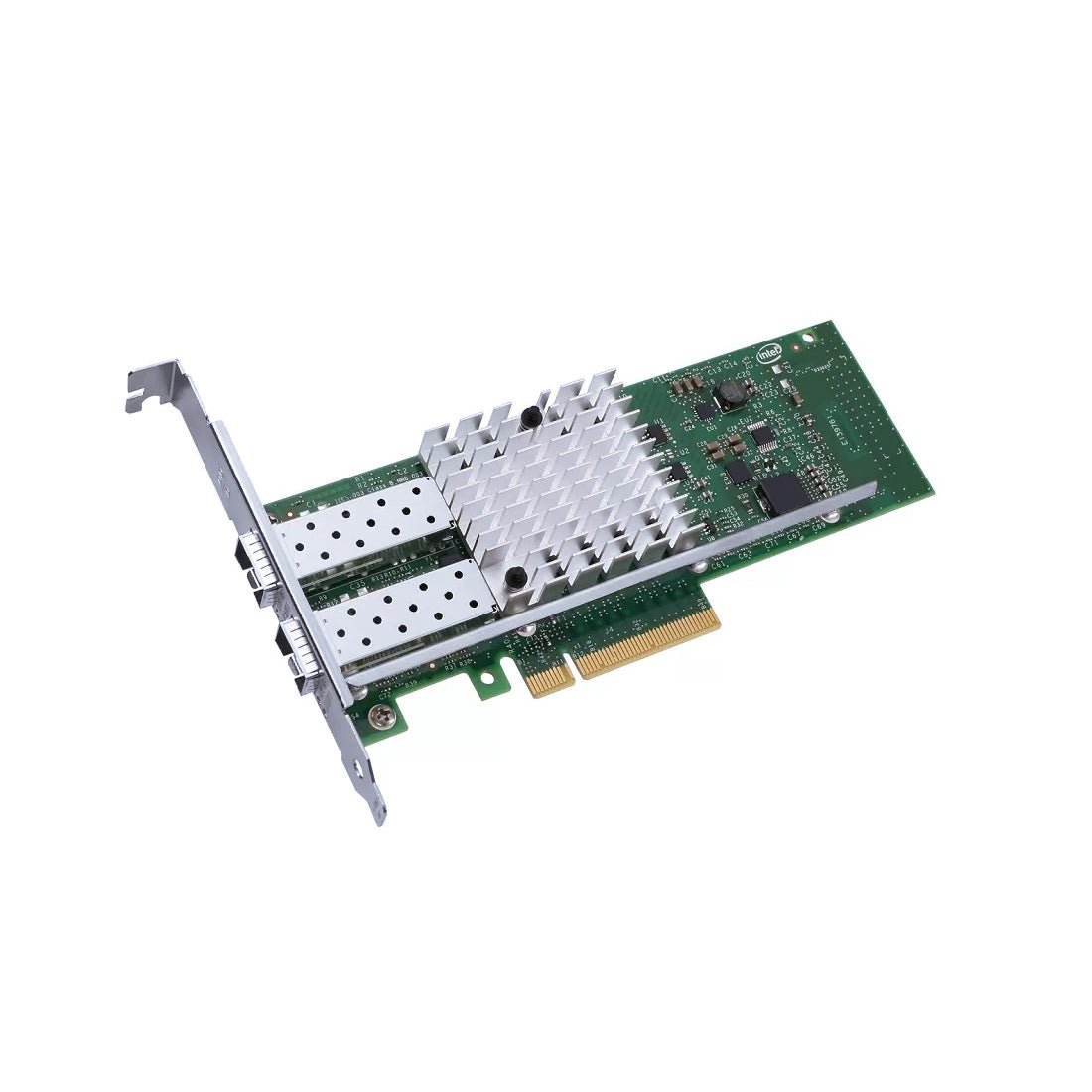
Intel® Ethernet Converged Network Adapter X520-DA2
INTEL-X520-DA2
Features and Specifications
- Advanced Virtualization Support: Supports SR-IOV and VMDq for efficient virtualized environments.
- Flexible Connectivity: Offers dual SFP+ ports for 10GbE connectivity.
- Energy Efficiency: Optimized for power efficiency.
- Robust Reliability: Built for 24/7 operation in demanding data center environments.
- UEFI Boot Support: Enables network booting and configuration through the UEFI interface.
- Load Balancing: Efficiently distributes network traffic across multiple CPUs.
- iSCSI and FCoE Support: Enables centralized storage area network (SAN) management and Fibre Channel over Ethernet.
- Direct Cache Access (DCA): Improves application response time by pre-fetching data.
- Low-Latency Interrupts: Reduces latency by minimizing interrupt overhead.
- Multiple Queues: Efficiently handles network traffic and prioritizes packets.
- Advanced Packet Filtering: Filters traffic based on various criteria.
Virtualization Features
- VMDq: Offloads data sorting from the hypervisor to the network adapter.
- SR-IOV: Provides virtualized network interfaces for improved performance and isolation.
- Virtual Machine Load Balancing (VLMB): Balances traffic load across virtual machines.
Manageability Features
- UEFI and PXE Boot: Enables network booting.
- iSCSI Boot: Enables booting from iSCSI storage.
- Intel® PROSet Utility: Provides easy configuration and management.
- SNMP and RMON: Supports network monitoring and management.
- Watchdog Timer: Monitors system health and initiates recovery actions.
Interface and Certifications
- Interface: PCIe 2.0 x8 (5 GT/s)
- Hardware Certifications: RCM, RoHS, FCC, UL, CE, VCCI, BSMI, KCC
- Certified Intel® with Brady ID


How long does shipping take?
Orders can take 3-14 business days to arrive, depending on stock levels and your location.
What is a Media Converter?
A media converter is a networking device that converts one type of network media, such as copper network cabling, to another, such as fibre optic network cabling. This is often used to extend network distances or connect different network types.
What is the difference between Single-Mode and Multi-Mode?
Single-mode fibre uses a thin core to guide light in a single path, enabling long-distance, high-bandwidth transmissions. Multi-mode fibre, on the other hand, has a thicker core that allows multiple light paths to travel simultaneously. While this can increase bandwidth over shorter distances, it can also lead to signal distortion due to the different light paths arriving at different times. This makes multi-mode fibre more suitable for shorter-distance applications, while single-mode fibre is better suited for longer-distance transmissions.
What is an SFP Module?
An SFP module is a small, hot-swappable device that plugs into media converters, switches, network cards, and routers. It provides various connectivity options, such as fibre optic or copper connectors.
What is the difference between Duplex and Simplex?
Simplex Fiber: A single-lane road. Usually, data only travels one way, but "Bi-Di" technology allows two-way traffic on that one lane by using two different colors of light.
Duplex Fiber: A two-lane road. Data travels both ways at once because there are two separate strands of glass—one for sending and one for receiving.
What is PoE (Power Over Ethernet)?
PoE technology transmits electrical power along with data signals over Ethernet cables, eliminating the need for separate power outlets and simplifying network installations, especially for devices like IP cameras and VoIP phones.
What is the difference between Ethernet (Cat) cables?
Ethernet categories (Cat5e, Cat6, Cat6a, etc.) define the speed and frequency the cable can handle. As the number increases, so does the performance.